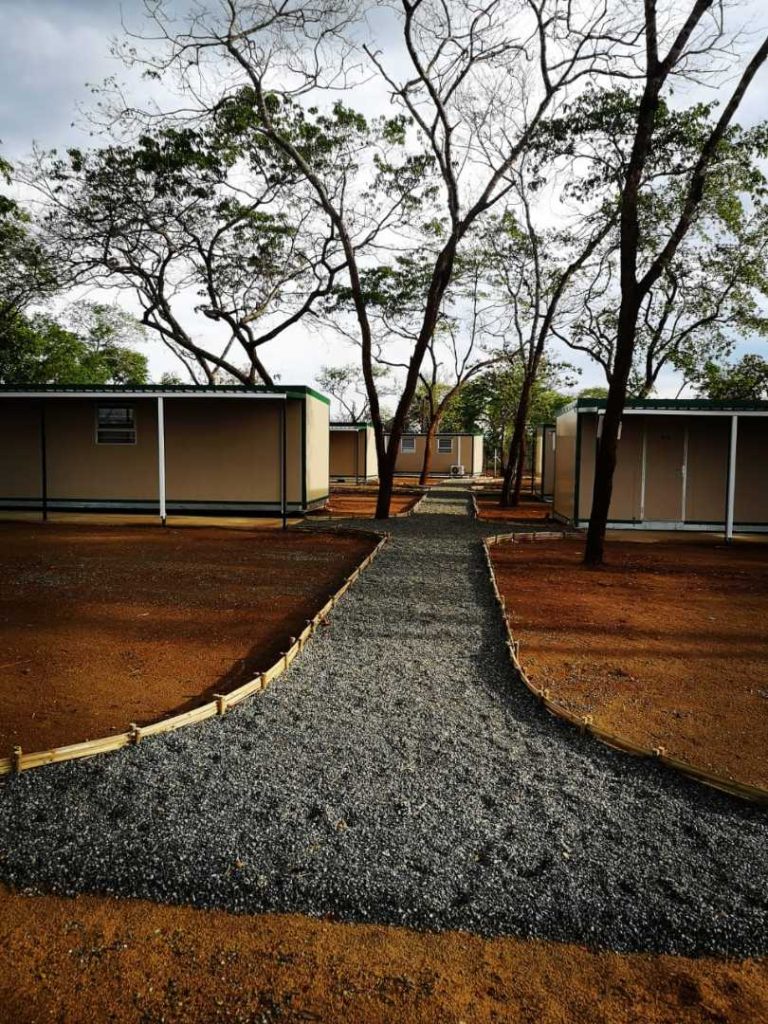
Turnkey remote site facilities require more than supplying individual buildings.
A remote project usually needs a coordinated facility package: accommodation, ablutions, offices, kitchens, diners, laundries, clinics, workshops, warehouses, storage, utilities, logistics planning, installation sequencing, and clear battery limits.
RapidBuild supports remote project teams with prefabricated and modular building systems for mining, infrastructure, oil & gas, agricultural, and remote construction projects across Africa.
What Turnkey Remote Site Facilities Need to Achieve
A remote site facility must support the people, services, and operations needed to keep a project running.
The buildings must work together as a practical site solution. Accommodation must connect logically with ablutions. Kitchens and diners must suit the camp size. Offices must support project control. Clinics, workshops, storage, and welfare buildings must fit the site layout and operating requirements.
When facilities are planned in isolation, the project team often faces scope gaps, interface problems, service clashes, installation delays, and unnecessary cost.
Typical Remote Site Facility Components
Remote site facilities usually combine several building types and support functions.
Accommodation Buildings
Accommodation may include worker rooms, ensuite units, dormitories, supervisor accommodation, management accommodation, and support housing.
The correct system depends on room repetition, comfort standard, relocation requirements, installation speed, and project duration.
Ablutions and Change Rooms
Ablutions need careful coordination around toilets, showers, basins, change rooms, lockers, drainage, hot water, ventilation, cleaning, and maintenance access.
Wet-area buildings must be planned properly from the start.
Kitchens, Diners, and Laundries
Camp support buildings must account for hygiene, food preparation, storage, serving flow, seating capacity, laundry loads, water supply, drainage, ventilation, extraction, and electrical demand.
These buildings must work under daily operational use.
Site Offices and Administration
Remote project offices support management, meetings, procurement, document control, engineering, HSE, QA, contractor coordination, and reporting.
The office layout should support how the project team actually works.
Clinics and Welfare Facilities
Remote projects often require clinics, first-aid rooms, welfare buildings, isolation spaces, and support facilities for staff wellbeing.
These spaces need cleanable finishes, privacy, ventilation, power, plumbing where required, and practical access.
Workshops, Warehouses, and Stores
Operational support facilities may include workshops, warehouses, maintenance buildings, parts stores, tool stores, and equipment support structures.
These buildings often require larger spaces, durable materials, vehicle access, roller shutters, ventilation, and lighting.
Choosing the Right System for a Turnkey Facility
A turnkey facility may require more than one building system.
RapidBuild reviews the project conditions before recommending the best system or combination of systems.
Flat Pack Modular Buildings
Flat pack modular buildings are useful where compact transport, fast installation, repeatable layouts, factory preparation, and future relocation matter.
They can be used for accommodation, ablutions, offices, clinics, laundries, kitchens, diners, and repeatable camp buildings.
RapidCabin
RapidCabin is useful where containerised delivery and practical site assembly are important.
It can suit remote sites where crane access is limited or where fully assembled modules are not the best logistical option.
RapidSpan
RapidSpan is suited to long-term site facilities where durability, larger internal space, and semi-permanent or permanent use are important.
It can be used for long-term offices, workshops, warehouses, clinics, packhouses, accommodation, ablutions, and operational support buildings.
Key Turnkey Facility Planning Considerations
Site Layout
The facility layout must account for movement of people, vehicles, services, deliveries, waste, food, water, maintenance, safety, and future expansion.
A good building system can still fail if the site layout is wrong.
Battery Limits
Turnkey projects require clear responsibility boundaries.
The proposal must define who is responsible for design, foundations, offloading, cranes, installation, services, connections, commissioning, furniture, permits, testing, and handover.
Services Coordination
Remote facilities depend on electrical supply, water supply, wastewater, drainage, HVAC, fire systems, hot water, data, ventilation, and backup systems.
These must be coordinated before procurement and installation.
Logistics and Transport
Transport route, port handling, border crossings, permits, container loading, abnormal loads, road conditions, site access, laydown areas, and offloading equipment must be planned early.
Logistics mistakes can destroy the savings of a cheaper building price.
Installation Sequence
The installation sequence must match civil readiness, building delivery, crane availability, labour availability, service connections, commissioning, and handover.
Remote projects need sequencing discipline.
Environmental Exposure
The building specification must reflect corrosion, humidity, heat, UV exposure, rainfall, wind, dust, and operational wear.
Material selection should be based on the site environment, not only upfront cost.
Common Mistakes in Turnkey Remote Facility Projects
Treating Turnkey as One Simple Package
Turnkey does not mean unclear scope. It means more responsibility must be clearly defined.
If responsibilities are vague, the project team ends up managing disputes, delays, and missing items.
Choosing Buildings Before Understanding the Site
The system should not be chosen before site access, logistics, services, labour, cranage, foundations, and project duration are understood.
Underestimating Services
Water, wastewater, power, HVAC, fire, drainage, and hot water often create more problems than the building shell.
Ignoring Interfaces
Civil works, building supply, MEP services, furniture, commissioning, and handover must be coordinated.
Remote site failures often happen at the interfaces between scopes.
Buying on Lowest Building Price
The lowest building price may not be the lowest project cost once transport, installation, delays, rework, maintenance, and lifecycle performance are considered.
Turnkey Facility Planning Checklist
Before requesting a proposal, confirm:
- Project country and site location
- Facility types required
- Number of occupants or users
- Temporary, relocatable, semi-permanent, or long-term use
- Required project life
- Site layout or available footprint
- Transport route and access constraints
- Crane and offloading availability
- Installation labour availability
- Foundation responsibility
- Water supply strategy
- Wastewater or septic strategy
- Electrical supply and backup requirements
- HVAC and ventilation requirements
- Fire and safety requirements
- Furniture and equipment requirements
- Documentation and compliance standards
- Required delivery date
- Scope battery limits
- Budget range or procurement constraints
Why RapidBuild
RapidBuild helps project teams review remote site facility requirements before the wrong system, specification, or delivery model is locked in.
The focus is to identify project risks early, clarify scope boundaries, and recommend the most practical prefabricated or modular building approach for the site.
The right answer may be flat pack modular buildings, RapidCabin, RapidSpan, or a hybrid facility package.
Start With a Project Review
You do not need a complete turnkey specification before contacting RapidBuild.
Send the basic project details: location, facility types, number of people, project stage, timing, site access, services assumptions, and known scope gaps.
RapidBuild will review the remote site facility requirement and recommend the next practical step.